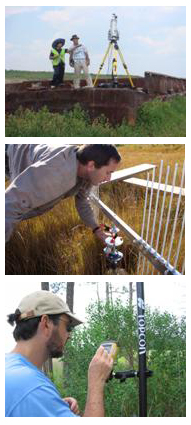
Ecosystem and Climate Operations

The NGS Ecosystem and Climate Operations (ECO) Program adapts geodetic survey technologies, instrumentation, and procedures in support of coastal community resilience, ecosystem services, and ecological integrity; especially in responding to climate change. ECO conducts collaborative research and development across several NOAA line offices, especially within the traditional Navigation Services: the National Geodetic Survey, the Center for Operational Oceanographic Products and Services and the Office of Coast Survey. ECO has also helped lead NOAA's efforts to establish Sentinel Sites for monitoring the impact of changing sea levels and coastal inundation.

NGS' Ecosystem and Climate Operations now has a partner newsletter!

Click here to see past newsletters.

NGS ECO News

04/22/13 - ECO Trains Waquoit Bay NERRS Staff

ECO was in Waquoit Bay, MA the week of April 22 to train NERRS staff on GPS and leveling techniques. ECO conducts regular trainings with the NERRS staff to support accurate elevations in coastal regions, which are necessary for resilience planning and natural resource management. Accurate elevations are a critical element supporting the NERRS Sea Level Sentinel Site Initiative. Through this and other trainings, ECO hopes to prepare NERRS staff to conduct their own surveying work within each site.

03/08/13 - NGS Assists Smithsonian's Tropical Research Institute to Provide Critical Sea Level Observations

The week of March 4, NGS ECO assisted the Smithsonian's Tropical Research Institute in Bocas del Toro, Panama, with the establishment of a new tide gauge to provide critical sea level observations in support of the Smithsonian Institution's Marine Global Earth Observatory (Marine GEO). The Smithsonian is investing in monitoring infrastructure at its Caribbean laboratories to bring them in line with similar observations being made within the NOAA Sentinel Site Program. These investments will help establish a pan-Caribbean sentinel site network and provide much needed sea level information in the region. As part of this work in Panama, ECO trained Smithsonian staff in the operation and maintenance of the physical infrastructure, as well as data processing, to ensure strict quality control measures remain in effect over the long term.

02/22/13 - NGS' ECO Sends Inaugural Newsletter

In February 2013, NGS ECO sent its first newsletter to partners across public, private, and government sectors. The newsletter, to be distributed every one to two months, will update partners on ECO activities as well as highlight the importance of geodesy and remote sensing as they apply to coastal science and ecology.

02/13/13 - ECO attends Northeast Roundtable

NGS Geodetic Advisor to Vermont, Dan Martin, joined a roundtable in Portsmouth, New Hampshire aimed at increasing partner access to NOAA's regional resources and increasing NOAA's understanding of partner needs. The NH Climate Adaptation Workgroup identified marsh migration as a priority concern, and NGS ECO can help provide resources for the study and evaluation of marsh health relative to land elevation and water levels.

01/23/13 - ECO in the Gulf of Mexico

NGS Geodetic Advisor to Florida, David Newcomer, presented a poster and a talk at the 2013 Gulf of Mexico Oil Spill and Ecosystem Science Conference in New Orleans, LA. Both presentations highlighted the important role of high accuracy elevations in low-lying coastal areas, especially in regions of high subsidence and restricted tidal range. Dave also presented information on the latest improvements to the NSRS, and our collaboration on sentinel site initiatives.

12/11/12 - Partnering with NERRS in Building Sentinel Site Infrastructure at Cape Cod

The week of December 3, National Geodetic Survey (NGS) staff and the Waquoit Bay National Estuarine Research Reserve (WB NERR) completed one year of monitoring the stability of wetland-based local geodetic control networks. Vertical reference marks for geodetic control networks are not typically set in wetland soils; they are usually found in upland soils, on rock outcrops, or on the foundations of large infrastructure, such as bridges and large buildings. As part of the NERRS Sentinel Site Program (SSP), local geodetic control networks are required to connect any number of vertically-based observations, such as local water levels, wetland elevation change, accretion/erosion, and along the intertidal gradient where particular vegetation communities are able to survive. However, the remote locations of many of these sites mean that traditional upland geodetic control networks are unavailable.

Show/Hide Older News

11/26/12 - NGS Joins Tidal Datum Workshops

The National Estuarine Research Reserve System (NERRS), in their effort to establish sentinel sites to monitor long-term environmental changes, have continued meeting with NOAA for assistance in accurately computing local water levels. NGS ECO has been working closely with the Center for Operational Oceanographic products and Services (CO-OPS) to develop content and ensure that the needs of the NERRS are met with regards to tidal and geodetic datums. The training has involved two webinars in November, and a hands-on training session at the NERRS annual meeting (11/26 - 11/30).

9/17/12 - NGS Contributes to Chesapeake Bay-wide Climate Planning Effort

On September 10, NGS ECO attended a workshop aimed at developing a regional "sentinel site" framework that will ultimately help coastal decision makers prepare for the impacts of sea level change in the Chesapeake Bay region. The framework will support collaboration between federal, state, and local governments as well as academic and non-profit organizations. The Chesapeake Bay is one of five regions across the country selected to be pilots for this sentinel site concept. See VIMS' Chesapeake Bay Sentinel Site Cooperative website here for more information.

6/13/12 - NGS ECO Co-author Talks at SWS and INTECOL Conference

At this year's conference in Orlando, FL, surface elevation table (SET) data from a collaborative project at Poplar Island was presented by co-author, Lorie Staver from University of Maryland's Center for Environmental Sciences. Another presentation focused on guidelines for the use of SETs to measure wetland surface elevation change...more.

4/20/12 - NOAA Employees and Partners Find Innovative Ways to Meet Constituent Needs More Quickly and Cost Effectively

Last week, NOAA's National Geodetic Survey (NGS) provided custom training on geodesy and geodetic surveying for 11 representatives from 7 National Estuarine Research Reserves System (NERRS) sites. This training represents a critical element supporting both the NERRS Sea Level Sentinel Site Initiative, as well as the larger NOAA Sentinel Site Program...more

3/28/12 - NOAA Provides Support for U.S. Fish & Wildlife Service's Texas Coastal Monitoring System

On March 27-28 at the Aransas National Wildlife Refuge, the U.S. Fish and Wildlife Service (FWS) hosted an annual meeting for all Texas coastal refuges. This year's theme focused on a newly-funded initiative to install a state-wide coastal monitoring network. The network will be based on a clustering of similar monitoring infrastructure and protocols at all eight coastal refuges....more

2/27/12 - Changes in the NGS ECO team

The NGS ECO team has experienced some exciting changes in the last few months. Galen Scott, former ECO team lead, is pursuing his PhD at the University of Rhode Island Environmental Data Center with the Environmental and Earth Sciences group and will therefore be absent from the ECO team for the next year and a half. Christine Gallagher has stepped in to take over the functions of team lead. She is working closely with external partners and other NOAA offices to develop new projects and move ECO forward. Philippe Hensel is continuing as lead researcher on Surface Elevation Tables and other coastal applications of surveying technology, as well as assisting partners with projects which require precise wetland and coastal elevations. Aria Remondi will be working on special projects with the NGS ECO team, including maintaining and continuing the development of ECO's web presence. Check this space frequently for more updates!

12/5/2011 - NGS and Partners Study Bench Mark Stability in Coastal Marshes at Waquoit Bay, MA

The National Geodetic Survey (NGS) successfully completed a mission in the Waquoit Bay National Estuarine Research Reserve (NERR) the week of December 5. Working in partnership with the U.S. Geological Survey (USGS) and the National Park Service, NGS trained NERR staff in deep rod mark-setting and high-precision digital barcode leveling procedures....more

7/26/2011 - NGS Hosts Geographer from National Park Service

The week of July 18th, NGS hosted Neil Winn, a geographer from the National Park Service stationed at the Assateague Island National Seashore. Over the past year, Winn has been developing a local geodetic control network throughout the entire Assateague Island to monitor barrier island migration and the positional evolution of critical dune habitats as environmental (and sea level) conditions change....more

6/14/2011 - NOAA collaborates with the Smithsonian Institution to Study Sea-level Change History in Belize

From June 15 to June 23, NOAAs National Geodetic Survey (NGS) ECO team installed precise positioning infrastructure and conducted fieldwork off the coast of Belize in Central America to assist the Smithsonian Institution in reconstructing sea-level change history since the last ice age. NGS also conducted a series of simultaneous Global Navigation Satellite System (GNSS) observations on several islands....more

12/14/2010 - NOS Explores Partnership with the Smithsonian Environmental Research Center (SERC)

On Friday, December 10, representatives from NOAAs National Geodetic Survey (NGS) met with researchers and administrators at the Smithsonian Environmental Research Center (SERC) in Edgewater, MD, to explore ways in which NGS may assist SERC in developing a high- accuracy local geodetic control network....more

12/14/2010 - U.S. Fish and Wildlife Service Seeking to Expand Development and Use of High-accuracy Geodetic Control Network across Coastal Refuge System

The U.S. Fish and Wildlife Service (FWS) has recently turned to NOAAs National Geodetic Survey (NGS) for assistance in the application of Global Navigation Satellite System (GNSS) technology to obtain high-accuracy positions and elevations across its northeast coastal refuge system....more

12/02/2010 - Floating Real-Time Global Navigation Satellite Systems to Validate Mobile Bay Circulation Model

This week the NOAAs National Geodetic Survey (NGS), Office of Coast Survey (OCS), and Center for Operational Oceanographic Products ` and Services (CO-OPS) began a 90-day deployment of seven Real-Time Global Navigation Satellite System (RT GNSS) "floats" at strategic locations...more

02/17/2010 - NGS Showcases Non-traditional Applications of LiDAR Technology at 2010 NOAA Heritage Week and on Fox 5 News

On February 5, the National Geodetic Survey (NGS) showcased its terrestrial Light Detection and Ranging (LiDAR) scanner at the NOAA Science Center to NOAA staff and FOX 5 News during the sneak preview of the 2010 NOAA Heritage Week...more